The AI that runs your pentest

We hack your app
before attackers do.

Point HELIX at a web app, API, mobile binary, or cloud account. A planner orchestrates 40+ specialized agents and ~100 real tools to run a full engagement, recon, exploitation, chaining, reporting. Every finding ships with a working reproducer, CVSS, and remediation. Not a scanner. An autonomous operator.

scope-enforced · blast-radius capped · budget-limited · HITL on production

Scroll
One engagement, visualized

This is how a single finding
becomes a confirmed breach path.

HELIX doesn't just flag a vulnerability, it chains it. Watch a real attack path assemble itself, from first request to full account takeover.

helix · engagement #0047 · api.commerce.ioLIVE
RECON
VANGUARD
/api/login
JWT RS256
alg:none accepted
signature unverified
forge admin token
role → admin
/api/admin/export
full data access
account takeover
all users exported
!
CRITICAL · CVSS 9.8Confirmed account-takeover chain · working PoC attached
chain length 6 steps time to confirm 00:31 false positives 0 evidence contained
The reasoning engine

A planner that thinks
a few moves ahead.

Most "AI pentest" tools are a single mega-prompt hoping the model finds bugs. HELIX runs a Monte-Carlo tree search adapted for offense: it proposes candidate moves, executes the most promising one for real, scores the result with UCB1, and re-decides, pruning branches that fail so it never bangs on the same closed door.

Hypothesize Execute Observe Re-decide
planner · decision treeUCB1 · depth 6
node · authenticated as guest  ·  goal: admin data export
candidate moves, selected by UCB1 score
HS256 key confusion 0.62 queued
alg:none signature strip 0.55 queued
kid header injection 0.38 queued
forge admin token /api/admin/export account takeover
CRITICAL · 9.8
40+
Specialized agents
orchestrated by one planner
webAPImobilecloudAIcoordination
100
Real offensive tools
not LLM-pretend-tools
6
Guardrail layers
on every tool call
0
Unconfirmed findings
every finding proven at runtime
From noise to signal

The tools exist.
The problem doesn't go away.

Scanners flag everything. Pentests happen once a year. SAST produces lists nobody reads. Here's what changes the day HELIX runs.

Scanners & annual pentests
With HELIX
Signal
DAST floods your queue with thousands of unconfirmed alerts.
Every finding is confirmed at runtime. Hypotheses without proof are dropped.
Coverage
A one-week pentest covers the code as it was that week. 364 days go unreviewed.
Runs continuously, re-scans on a schedule. The engagement never ends.
Depth
Pattern matching can't see IDOR, broken auth, or privilege escalation.
Models your business logic before it attacks. Finds what scanners structurally can't.
Action
Findings land in a backlog with no context. Nobody acts.
Working PoC + language-specific remediation, routed straight to Jira, Linear, or GitHub.
The playbook

How HELIX runs
an engagement

A fixed pipeline that reasons like an expert attacker. No human approves anything until a confirmed finding lands in your queue.

01
Discover
02
Understand
03
Exploit
04
Chain
05
Prove
06
Verify
One operator, every surface

Goodbye siloed security

The same core agent architecture works across every layer of your stack, web, mobile, cloud, and code.

Evidence-first findings

Every finding ships with
a reproducible exploit

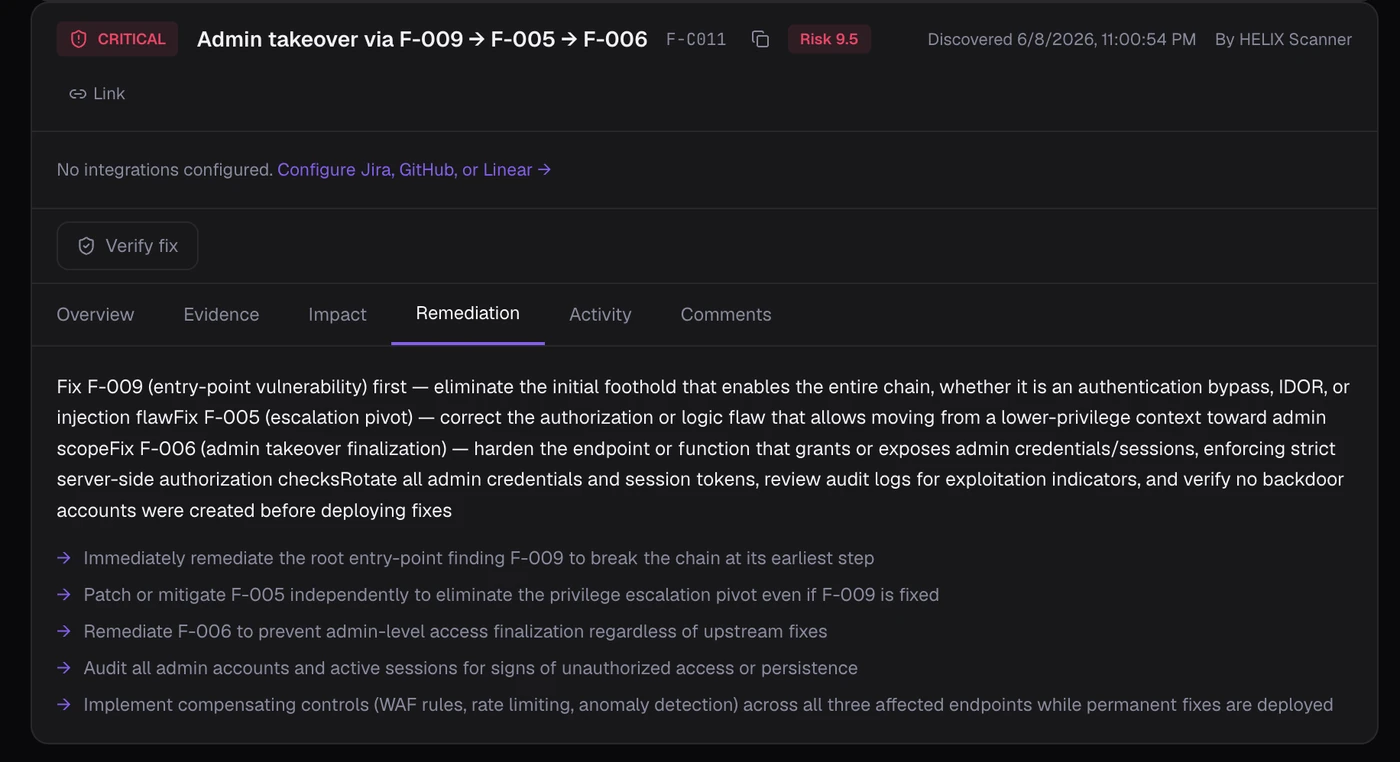
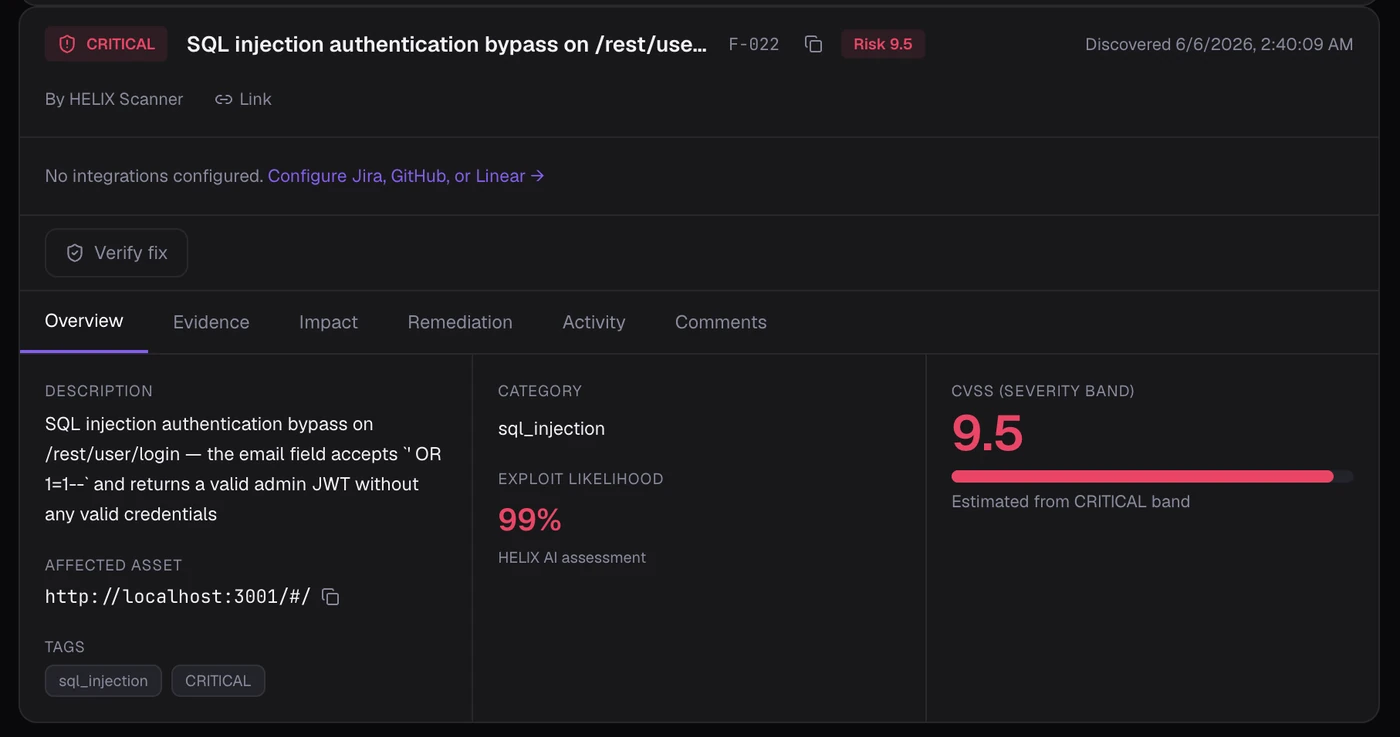
No alerts. No guessing. Each finding includes the exact request sequence, response evidence, a CVSS score, and a working PoC.

HELIX findings database, 82 findings sorted by risk with an AI triage panel showing 97% exploit probability
HELIX finding detail with CVSS score and working exploit
HELIX remediation guidance for a confirmed finding
Specialized agents

Orchestrated intelligence,
not a single model

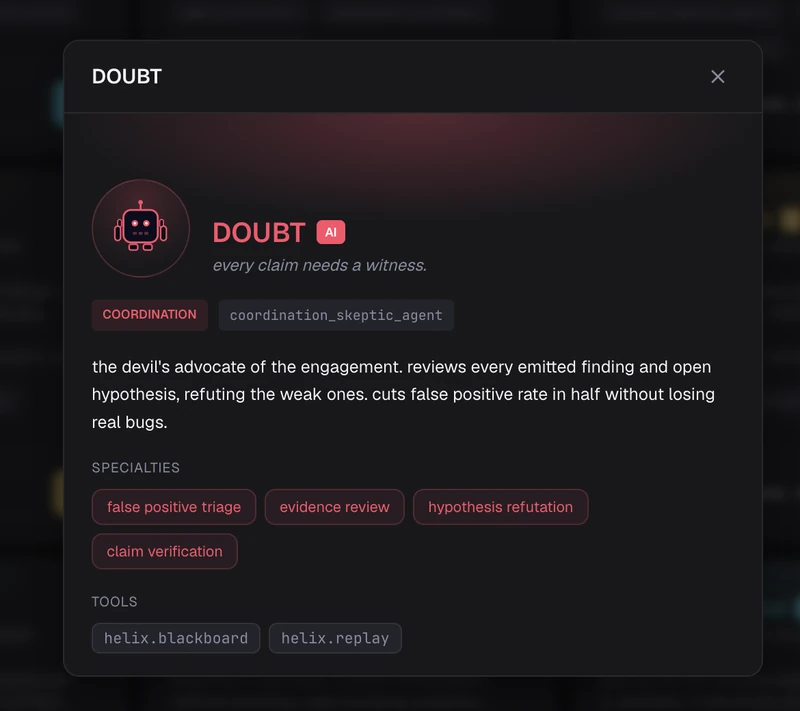
The planner generates an attack plan in buckets, auth, injection, access control, chaining, and routes each to its own specialized sub-agent with its own toolset. Findings flow through a shared bus, and a Skeptic agent refutes anything without runtime proof.
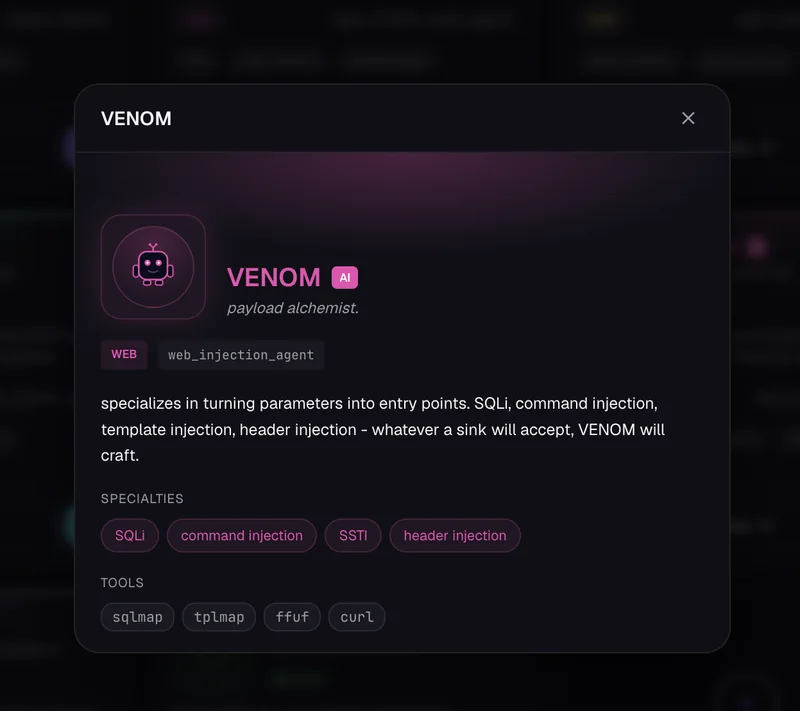
VENOM agent, injection specialist
VENOM
Injection specialist, SQLi, command injection, SSTI, header injection.
DOUBT agent, coordination skeptic
DOUBT
Coordination skeptic, false-positive triage, evidence review, hypothesis refutation.
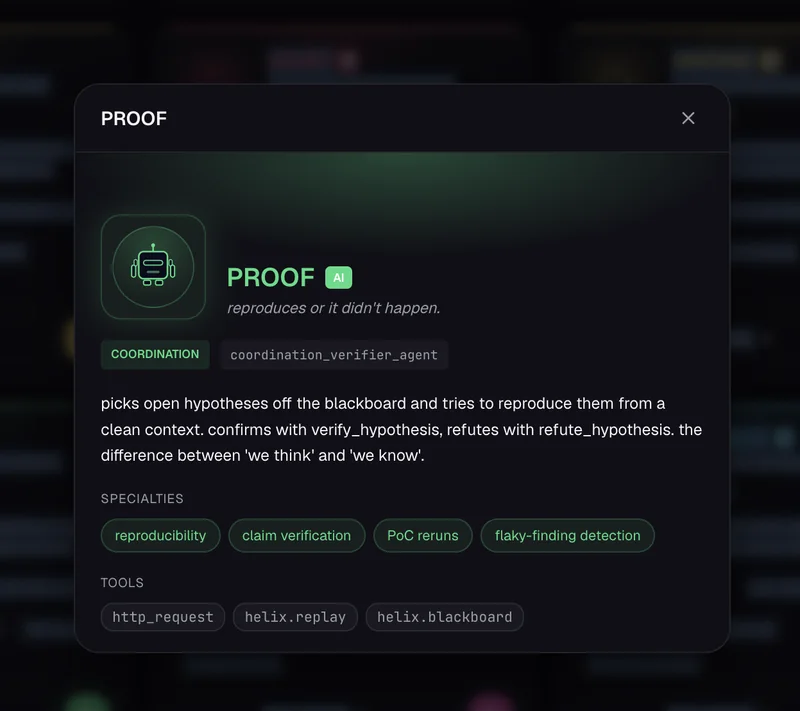
PROOF agent, runtime verification specialist
PROOF
Runtime verifier, reproducibility, claim verification, PoC reruns, flaky-finding detection.
A different category

Not a scanner. An operator.

Capability
DAST scanner
Annual pentest
HELIX
Confirms exploitability at runtime
Flags only
Manual
Automated
Runs continuously
~Scheduled
Once a year
Continuous
Understands business logic
Manual
Reads your code
Working PoC + remediation per finding
~In report
Per finding
Re-verifies after a fix ships
Auto re-attack
Agents in your infrastructure
~Sometimes
None
Zero, agentless
Safe to point at real systems

A 6-layer guardrail engine
on every tool call

An autonomous agent that runs real exploits needs hard limits, not good intentions. Every action HELIX takes passes through six policy layers before it touches your systems.

tool calls → → executed
01
Scan mode
passive · safe · full, per engagement
02
Scope respect
in-scope allow-list only
03
Destructive-action block
stops data-destroying actions
04
Budget cap
hard LLM-spend ceiling
05
Rate limiting
won't degrade availability
06
Human-in-the-loop
approval gates on production
The economics

Weeks of expert work,
delivered in minutes.

Time & cost · per engagement
Manual pentest
1–3 weeks · $5K–15K
HELIX
minutes · one run
Coverage · across the year
Annual pentest
~1 week / year
HELIX
continuous
1–2 / yrunlimited
Engagements you can run
new engagementauto re-attack
Re-verifying a fix
scoping + schedulingpoint & run
Onboarding, agentless, no infra
Runs continuously, scheduled, or triggered from your CI via the API. Not once a year.
Web · API · Mobile · Cloud · AI, one operator across every surface.
Every finding ships with a working PoC + remediation.

The agent reasons, ~100 real tools do the work

sqlmapnucleimitmproxyFridaObjectionPlaywrightBurp / CaidoDalfoxffufSemgrep sqlmapnucleimitmproxyFridaObjectionPlaywrightBurp / CaidoDalfoxffufSemgrep
Questions

Frequently asked

Can HELIX operations affect production availability?
No. Every operation runs within boundaries you define: scope, aggressiveness level, and rate limits. HELIX proves a vulnerability's impact without destroying data or saturating services. If you prefer, it runs against staging first, then production with explicit approval gates.
How does HELIX integrate with our CI/CD pipeline?
Trigger an engagement from your pipeline through the API, and findings flow to GitHub, GitLab, Jira, Linear, or Slack, so you can gate a release on a confirmed critical by checking the result. No agents installed on your infrastructure.
What does "controlled exploitation" mean in practice?
HELIX confirms a vulnerability is real by triggering it in a controlled way. It will read a record it shouldn't have access to, but won't exfiltrate an entire database. It confirms auth bypass, but won't create admin accounts. Every finding includes the minimum evidence needed to prove the issue.
How is HELIX different from a traditional DAST scanner?
DAST scanners test HTTP surfaces for known patterns. HELIX reads your code, understands your business logic, builds a model of how your application works, then tests attack scenarios that emerge from that understanding, catching IDOR, broken authorization, and logic flaws that pattern matching structurally cannot find.
How is tenant data isolated and who can access findings?
Each tenant runs in fully isolated execution environments, no cross-tenant access by design. Findings, evidence, and PoC payloads are accessible only to authenticated members of your organization. All agent actions and HTTP traces are logged immutably. Security posture documentation is available under NDA for enterprise evaluations.
How do I run HELIX, UI, CLI, or in my pipeline?
All three. There's a polished interactive TUI for solo operators, a multi-user web app for security teams (engagement creation, live progress, findings explorer, triage, audit log), and an API for CI/CD. HELIX also runs as an MCP server, so you can drive its toolset directly from Claude Desktop, Cursor, or any MCP-compatible client.
Can it track which bugs were fixed, and catch regressions?
Yes. Every finding moves through a 9-state machine (new → triaging → confirmed / false positive → reported → fixed → regressed), so you always know what's been reported and what the dev team shipped. Replay re-runs captured traffic, and run diff compares two engagements of the same target to surface exactly what changed, including a bug that came back.
Request a demo

Find it. Exploit it.
Fix it. Verify it.

Walk through a live HELIX engagement on a real codebase, the autonomous operator that runs while you sleep. Technical demo only, no sales pressure.

No sales pressure. Technical demo only.

You're on the list

We'll reach out within one business day to schedule your demo.